An Error Taxonomy Study Loop for SAT Score Gains
Jamie

Why an error taxonomy beats “do more questions”
Most SAT score plateaus come from repeating the same kinds of mistakes with better intentions but the same review habits. An “error taxonomy” fixes that by forcing every missed (or guessed) question into a label you can act on. Instead of tracking only accuracy, you track why you missed, then convert that into a weekly loop: diagnose → practice the right thing → re-test → update.
The goal is simple: fewer repeated errors per week. That’s also why taxonomy-based review pairs well with adaptive practice systems like getsharp, where targeting weak spots only works if the weak spot is defined correctly.
The three labels that make your review actionable
Keep the taxonomy small. If you create 12 categories, you won’t use them consistently. For SAT gains, the most practical top-level labels are:
1) Concept errors
A concept error means you didn’t have (or couldn’t recall) a rule, definition, or underlying idea. Examples:
- Math: you don’t know what makes a function “linear,” or you forget how to interpret slope.
- Reading/Writing: you don’t know what “logical transition” questions are testing, or you can’t reliably identify subject–verb agreement.
Signature: When you read the explanation, you think “I didn’t know that,” or “I’ve seen it, but I can’t explain it.”
Best fix: a short relearn session plus a small set of targeted questions until you can explain the rule in your own words.
2) Process errors
A process error means you know the concept, but your method breaks down: you set up the wrong equation, choose the wrong evidence, or follow an unreliable strategy under time pressure.
- Math: you pick the right formula but substitute incorrectly or solve for the wrong variable.
- Reading: you can find evidence, but you don’t consistently eliminate choices or you chase “interesting” lines instead of relevant ones.
- Writing: you understand punctuation rules, but you don’t apply a repeatable approach (e.g., checking boundary commas) and end up inconsistent.
Signature: After review, you recognize you could have done it, but your steps weren’t disciplined or you didn’t check your work in the right places.
Best fix: standardize a mini-procedure (3–6 steps) and practice it deliberately. Process errors usually drop fastest when you tighten your checklist.
3) Careless errors
Careless is real, but it’s also the most abused label. Use it only when the concept and method were correct, but the execution failed: misread a negative sign, bubbled wrong, copied a number incorrectly, overlooked “NOT,” or made an arithmetic slip.
Signature: You can reproduce the correct solution quickly, and the mistake is clearly a lapse rather than a misunderstanding.
Best fix: a prevention habit, not more content. Examples: underline constraints, circle units, mark “EXCEPT,” do a 10-second end check, or use a “pause before selecting” rule on Reading.
How to label a mistake in under 60 seconds
To keep labeling consistent, use a quick decision tree right after review:
- Could I teach the rule? If no → Concept.
- Did I choose a reliable method and follow it? If no → Process.
- Was the method correct but execution slipped? If yes → Careless.
If you’re torn between two labels, default to process. “Careless” is only useful when it points to a specific prevention trigger you can adopt next time.
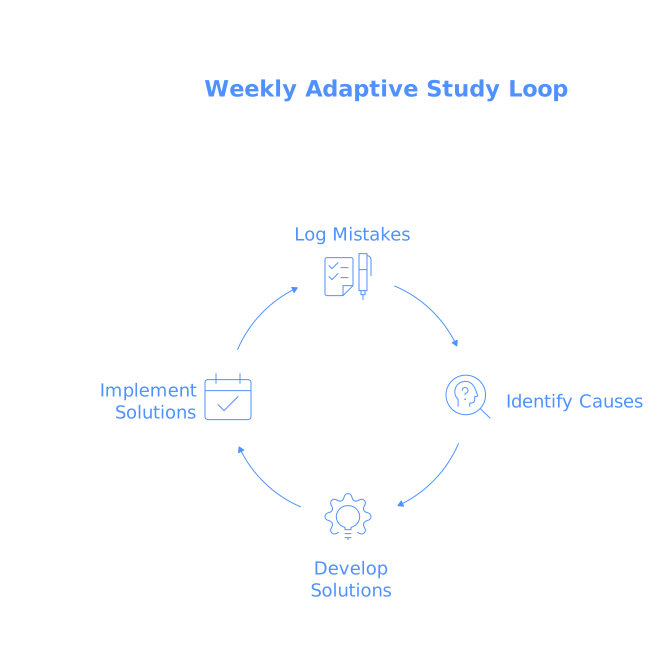
Turn labels into a weekly adaptive study loop
The mistake labels matter because they map directly to what you should do next. Here’s a weekly loop that stays lightweight but compounds quickly.
Step 1: Log only what you’ll use
After each set or practice test, capture five fields for every miss or unsure guess:
- Question ID (or a screenshot reference)
- Section and skill (e.g., “Transitions,” “Linear equations,” “Inference”)
- Your label: Concept / Process / Careless
- One-sentence cause (“Forgot rule for commas with nonessential clauses”)
- One-sentence prevention or fix (“Check if clause can be removed; if yes, set commas”)
This is the SAT version of paying down “feedback debt”: if you don’t capture the cause clearly, you’ll keep re-processing the same mistake later. (The pattern is similar to how teams lose time when requests repeat without clean labels; see how to spot duplicate requests.)
Step 2: Run a weekly “top three” error review
Once per week, sort your log by frequency and pick:
- One concept gap that appears multiple times
- One process breakdown that costs you points under time
- One careless pattern that repeats (e.g., missing “except,” sign errors)
Keep it to three. This prevents your plan from turning into an endless backlog, the same way product teams get stuck when everything becomes “urgent” and the real work disappears into a silent queue.
Step 3: Assign the right intervention per label
Use this mapping so your practice is actually adaptive:
- Concept: 15–25 minutes to relearn + 10 targeted questions. Stop when you can explain the rule and get 8/10 correct.
- Process: write a micro-checklist + 12 timed questions using that checklist. Review whether you followed the steps, not just whether you were right.
- Careless: choose one prevention trigger and apply it on the next two study sessions. Track whether the trigger happened, not whether you “tried harder.”
In getsharp, this is where targeted practice and explanations can become more than review: you can repeatedly hit the same skill until the category flips from “concept” to “process,” then tighten timing and consistency.
Step 4: Re-test the same category within seven days
Don’t wait a month to see if it worked. Within a week, do a short re-test (10–15 questions) focused on the same skill area. Your metric is repeat rate: how many mistakes are the same label and same cause as last week?
A good sign: concept errors drop first, process errors drop next, careless errors drop last but should become specific and rare.
Step 5: Update the plan, not your motivation
If your top errors don’t change week to week, your plan isn’t adapting. Adjust one variable:
- If concept errors persist: shrink the topic and drill fewer question types.
- If process errors persist: slow down and overemphasize steps, then add time pressure later.
- If careless errors persist: change your environment (phone away), add an end-check ritual, or force yourself to annotate constraints.
Common labeling mistakes that stall progress
Calling everything “careless”
If you label 70% of misses as careless, you’ve basically decided not to diagnose. “Careless” should point to a repeatable prevention habit, not an emotion.
Ignoring “unsure but correct” questions
Correct guesses often hide concept or process gaps. Log them the same way—especially in Reading and Writing where elimination skill matters.
Mixing skills inside one review session
If you missed three different comma concepts, treat that as one concept cluster. Adaptive practice works best when you isolate one lever at a time.
A realistic weekly schedule that doesn’t burn students out
- 2–3 days: 25–40 minutes targeted practice + quick labeling
- 1 day: 30 minutes weekly top-three review + interventions
- 1 day: short re-test set (10–15 questions) + update log
- Optional: one longer practice block or a full-length test every 2–3 weeks depending on test date
The point is not grinding hours; it’s closing the loop fast enough that mistakes can’t become habits.