Prevent GA4, Ads, and CRM Conflicts When Changing Your Revenue Source of Truth
Jamie
Why switching your primary attribution system creates metric conflicts
Teams usually change their “primary revenue attribution” for a good reason: the CRM is closer to cash, GA4 is better at behavioral analysis, and ad platforms are optimized for delivery and bidding. The problem starts when you treat any one of those tools as a universal source of truth.
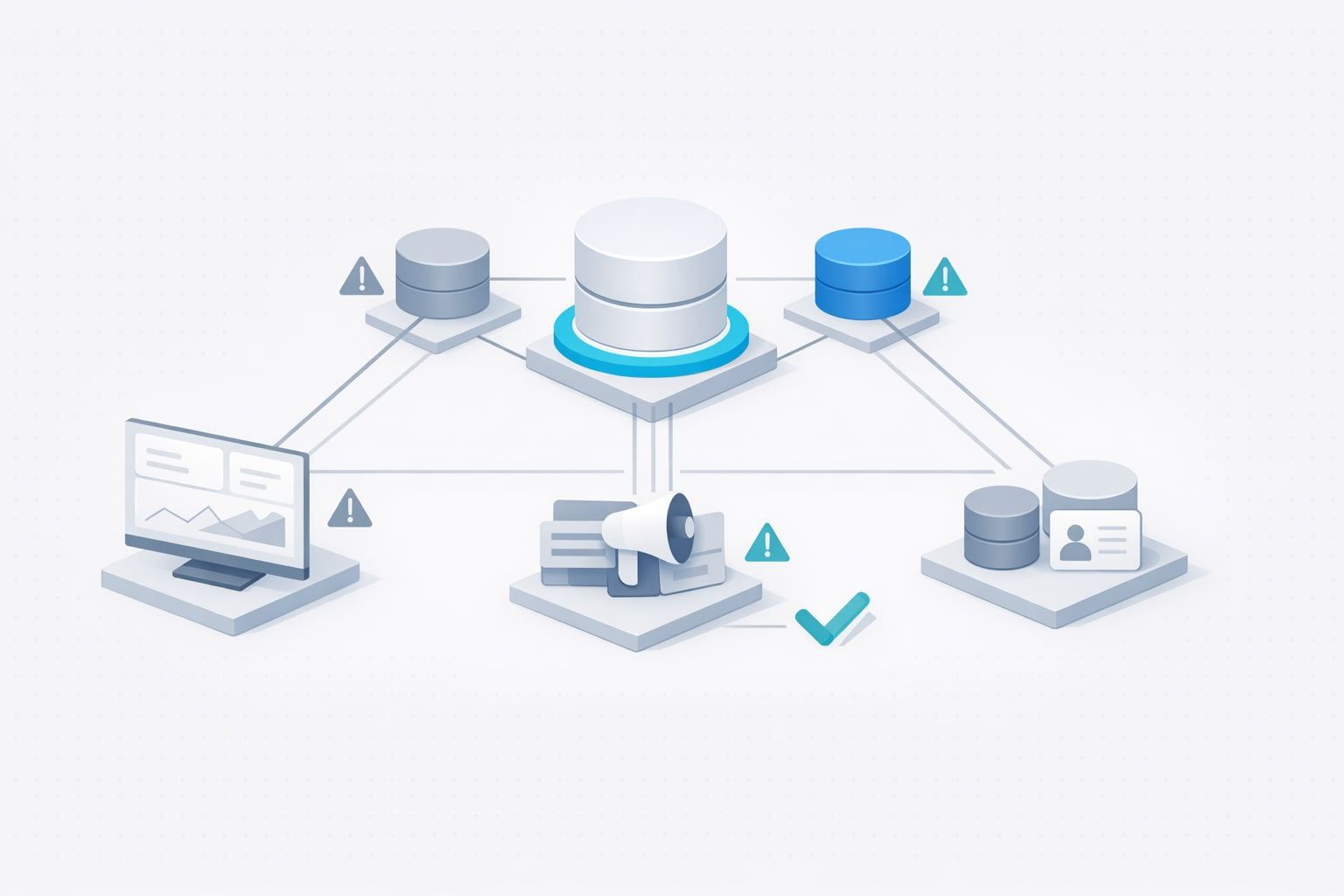
When you flip your primary revenue definition—say, from GA4 purchase revenue to CRM closed-won revenue—you don’t just change a number. You change identity rules, timing rules, and what counts as “revenue” in the first place. If you don’t make those rules explicit, mismatches multiply: CAC jumps overnight, ROAS “drops,” and executives question whether marketing suddenly broke.
The Data-Source-of-Truth Trap in practice
The trap looks like this: you declare a new source of truth (often the CRM), then you continue to compare every other tool to it as if they should match perfectly. They won’t—because each system answers a different question.
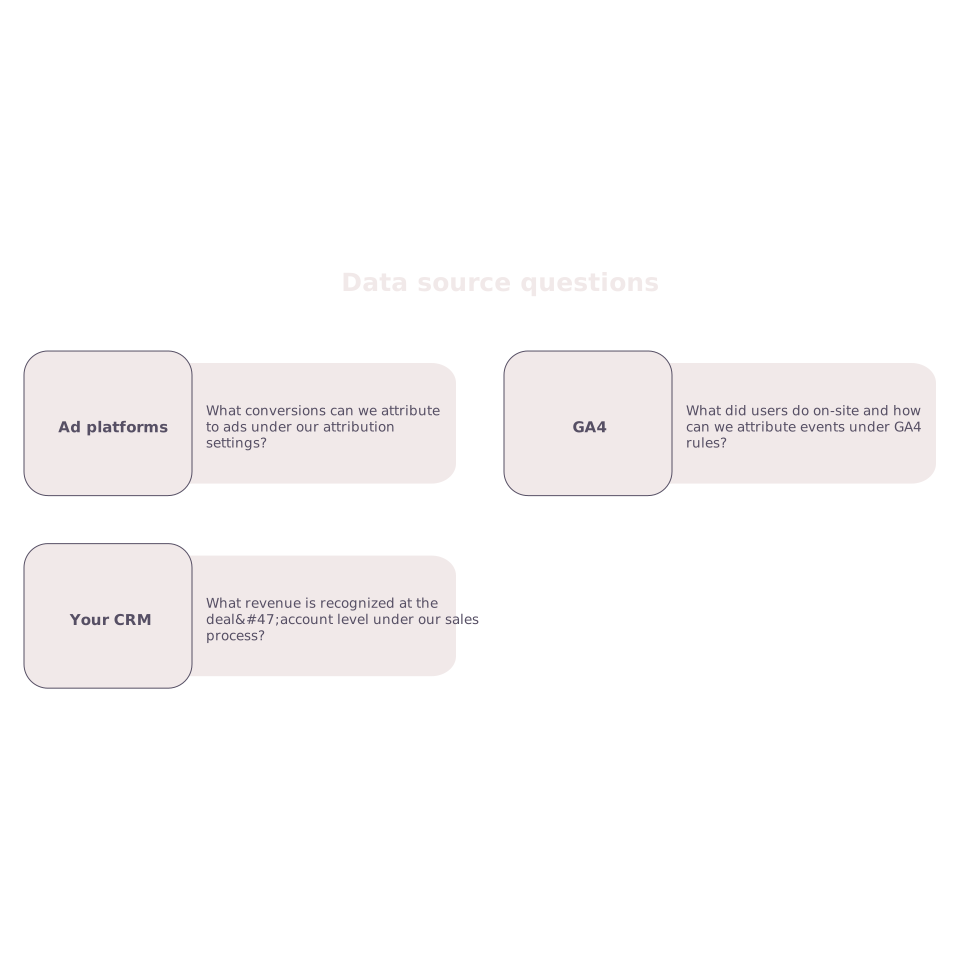
- Ad platforms answer “What conversions can we attribute to ads under our attribution settings?”
- GA4 answers “What did users do on-site and how can we attribute events under GA4 rules?”
- Your CRM answers “What revenue is recognized at the deal/account level under our sales process?”
Conflicts appear immediately after the switch because the old reporting muscle memory remains: you keep checking GA4 and Ads for “the” revenue number, but the definitions are no longer aligned.
Four mismatch categories you must reconcile before you switch
1) Identity mismatches: user, lead, contact, account
GA4 is session and user-centric. CRMs are lead/contact/account-centric. Ad platforms sit somewhere in between with click IDs and modeled conversions. If the same buyer appears as:
- three devices in GA4,
- two contacts and one merged lead in the CRM,
- and one conversion in the ad platform due to aggregation,
you’ll never reconcile totals without an explicit identity strategy. That strategy usually includes:
- a stable primary key (often CRM deal ID or subscription ID),
- supporting join keys (email hash where allowed, click IDs, GA client IDs),
- and documented merge rules (what happens when contacts merge or deals split).
2) Timing mismatches: event time vs. conversion time vs. revenue recognition
GA4 logs events at event time. Ad platforms may attribute conversions to the click time and report them after processing delays. CRMs often recognize revenue on close date, invoice date, or when payment clears.
If you switch to CRM “recognized revenue,” your daily marketing dashboards will look wrong unless you model delay. A deal created today might close in 21 days; GA4 would have recorded the checkout today, while the CRM revenue appears weeks later.
This is why teams see false CPA spikes and “sudden” ROAS drops after a switch. A practical mitigation is to set expectations with a delay model and only compare like with like. If you want a structured approach, the idea of a data-lag ladder helps you map which metrics stabilize after 1 day, 3 days, 7 days, and 30 days so you don’t react to incomplete data.
3) Definition mismatches: gross revenue, net revenue, ARR, refunds, discounts
GA4 purchase revenue might be gross at checkout. Your CRM might store ARR, MRR, net of discounts, or revenue after refunds. Ads platforms might optimize on conversion value you send back—sometimes excluding tax/shipping, sometimes including it.
Before switching your primary attribution, write down the canonical definition of revenue you want leadership to use. Examples:
- Net revenue: excludes refunds and chargebacks, may exclude tax.
- Booked revenue: value at deal close, may not equal cash collected.
- Recognized revenue: aligned to accounting rules, often delayed.
- ARR/MRR: subscription-normalized values that don’t map cleanly to one-time purchases.
Then define a translation layer for each tool, so “revenue” is never an unqualified field name in reporting.
4) Attribution mismatches: what “credited to marketing” means
Attribution is not the same as revenue. Switching your revenue source of truth doesn’t automatically settle attribution disputes; it can actually intensify them. GA4’s data-driven attribution, platform last-click, and CRM “source” fields can each be internally consistent while disagreeing with each other.
To prevent endless arguments, decide what the primary view is used for:
- Budget decisions: typically needs stable, comparable, policy-driven attribution rules.
- Product/UX measurement: GA4 behavioral flows may stay primary even if revenue is CRM-based.
- Sales ops forecasting: CRM pipeline and close rates remain central.
A practical migration plan that avoids broken dashboards
Run both systems in parallel with a reconciliation table
Don’t “flip the switch” on Monday and expect trust on Tuesday. Run a parallel period where you report:
- GA4 purchase revenue (old primary),
- CRM revenue (new primary),
- and a reconciliation view that explains the gap.
The reconciliation view shouldn’t be a spreadsheet of blame. It should be a categorized bridge: “timing,” “identity,” “refunds/discounts,” “offline conversions,” and “unknown.”
Lock metric names and create a governance rule
Most conflicts aren’t technical; they’re semantic. If “Revenue” means three different things in three dashboards, teams will cherry-pick the one that supports their point.
A simple governance rule helps: reserved names like Revenue (CRM Recognized), Revenue (GA4 Purchase), and Conversion Value (Ads Reported)—and no dashboard is allowed to label a metric “Revenue” without the qualifier.
Standardize transformations before the data hits reporting
The easiest place to lose trust is in manual exports and one-off calculations. Standardizing currency conversion, naming harmonization, and KPI calculations upstream reduces “mystery math” downstream.
This is where a marketing data infrastructure layer can help. Platforms like Funnel.io are designed to collect, normalize, and continuously refresh performance data across ad platforms, analytics, and CRMs, so transformations are consistent and auditable instead of copied into ten dashboards.
Model delays and publish “freshness” alongside KPIs
If you don’t publish data freshness, stakeholders will interpret partial data as performance change. Add fields like:
- last sync time per source,
- expected stabilization window per metric (e.g., “7-day complete”),
- and a “do not evaluate” flag for incomplete periods.
When leadership sees that today’s CRM revenue is structurally incomplete, you prevent panic-driven budget cuts.
What to do when leaders demand one number anyway
You can have one primary number, but only if you clearly label it and preserve secondary views for diagnostic work. A workable compromise is:
- Primary: CRM revenue (recognized or booked, whichever finance accepts).
- Operational: GA4 purchase revenue for same-day funnel health.
- Optimization: platform-attributed conversion value for bidding feedback loops.
The goal isn’t to force agreement across systems; it’s to prevent silent definition drift. If you need a deeper breakdown of why systems diverge and how to stop “why don’t these match” fire drills, see Stop Revenue Reporting Mismatches Between Your CRM Ad Platforms and Analytics.
The reliable end state
After the switch, success looks like this: GA4, Ads, and the CRM can disagree without creating chaos, because every dashboard clarifies (1) what definition is used, (2) what time logic applies, and (3) what attribution model is being reported. Your source of truth becomes a governed dataset, not whichever platform someone checked last.