LATAM payment orchestration routing matrix to improve approvals with method order and local fallbacks
Jamie

Designing a LATAM routing matrix that raises approval rates without adding friction
In Latin America, the fastest way to lose conversions is to treat payments like a single “card processor” problem. Approval rates vary sharply by country, issuer behavior, local schemes, currency, installment logic, and even descriptor format. Payment orchestration helps, but only if routing is defined as a matrix: a set of decision rules that selects the best method and acquirer path for each attempt while keeping checkout simple.
This article breaks down a practical routing matrix approach using three levers that typically lift approvals without adding steps: method order, soft descriptors, and local acquirer fallbacks. It also outlines what to measure so the matrix improves over time instead of becoming a static ruleset.
What a routing matrix means in LATAM payment orchestration
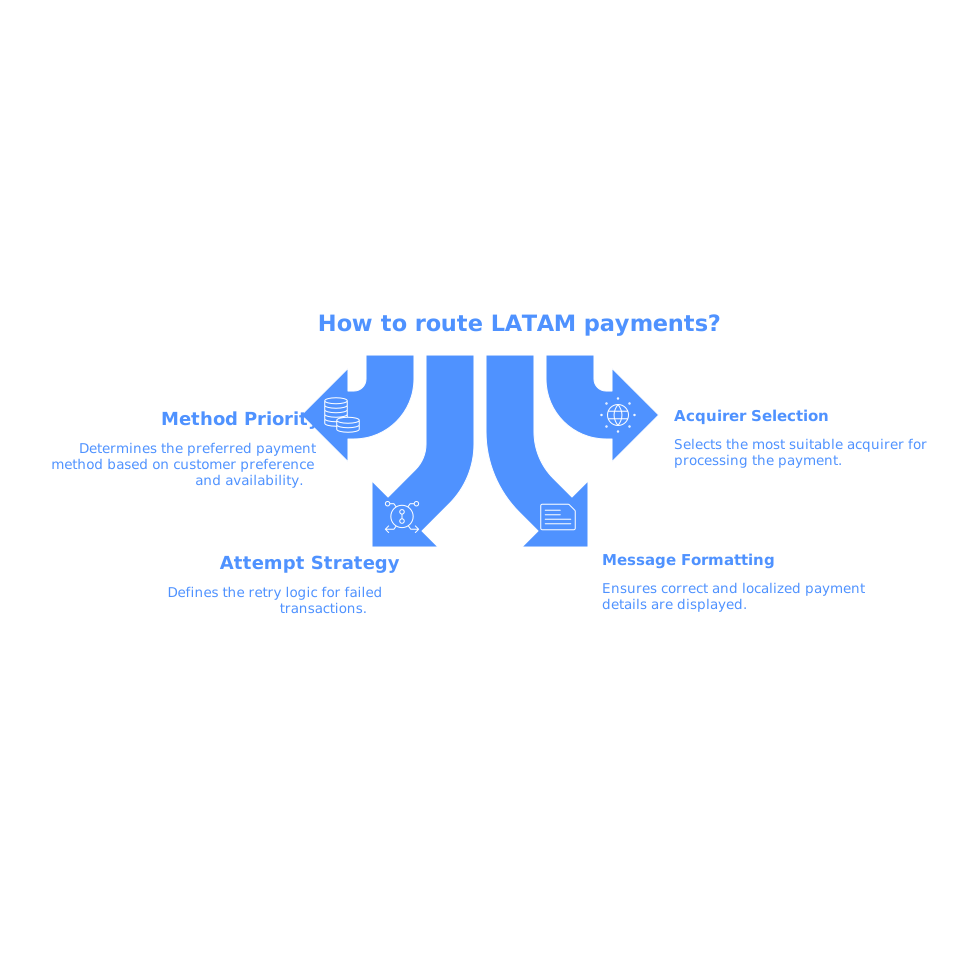
A routing matrix is the combined logic that decides:
- Method priority (cards vs local bank transfer vs cash-based methods vs wallets)
- Acquirer selection (local acquirer A vs local acquirer B vs cross-border acquiring)
- Attempt strategy (initial attempt, fallback, and retry cadence)
- Message formatting (descriptor, MCC where applicable, and localized metadata)
In LATAM, “best route” is rarely universal. Brazil behaves differently from Mexico; Mexico differs from Colombia; installment acceptance patterns in Argentina can change what “best” means for the same customer profile. The matrix gives structure so orchestration isn’t just random A/B testing at the payment rail level.
Lever 1: method order that matches local preference and issuer reality
Method order is the simplest lever because it is decided before the authorization even happens. The goal is not to show more steps, but to show the right method first for the buyer’s context, and to preserve a frictionless fallback if the preferred option fails.
Use a “default-first, not card-first” rule
Many global checkouts default to card entry. In LATAM, that can be suboptimal in countries where instant bank rails and wallets are dominant or where card approvals are sensitive to cross-border signals. A routing matrix typically starts with:
- Geo and currency signals: detect country and local currency to prioritize local rails.
- Device and intent signals: on mobile, wallets and instant transfer flows can outperform manual card entry.
- Merchant model: subscriptions often need a method that supports recurring payments reliably (cards or tokenized wallets), while one-off purchases can lean into bank transfer or cash methods without adding long-term complexity.
Keep checkout static while changing the ranking
“Without adding checkout steps” usually means: don’t add extra forms, don’t add extra redirects, and don’t require the buyer to understand why a method is recommended. The matrix can reorder the same set of methods in a localized embedded checkout so the buyer sees the highest-likelihood option first, while still allowing a quick switch.
Platforms built specifically for the region, such as Rebill, typically implement a localized checkout that adapts language, currency, and the available method set to each buyer. That adaptability is what makes method order a measurable approval lever rather than a design preference.
Lever 2: soft descriptors that reduce issuer uncertainty and disputes
Soft descriptors are the “statement descriptors” and related fields that appear to the buyer and may also influence issuer risk scoring. In LATAM, descriptor clarity matters because many declines are not “insufficient funds” but “do not honor” patterns driven by risk models, especially when the buyer doesn’t recognize the merchant name or the descriptor looks generic.
Build descriptor rules per country and per product line
A routing matrix should treat descriptor settings as configuration, not as a one-time legal text. Practical rules include:
- Local language where allowed: a recognizable merchant label in Spanish/Portuguese can reduce confusion.
- Short, stable naming: avoid frequent changes; stability helps recognition and support.
- Use a support identifier: where permitted, include a recognizable support token (e.g., brand + short help reference) to reduce chargebacks and support contacts.
- Separate brands/products: if you run multiple products, use distinct descriptors so a buyer’s memory matches the charge.
Coordinate descriptor with method order and post-failure messaging
Descriptors don’t exist in isolation. If your matrix prioritizes a wallet or bank method first, but your card descriptor remains generic, you may still see card declines on fallback. Similarly, if you run smart retries (common in subscription recovery), consistent descriptors and clear customer notifications reduce repeat declines and “card blocked” events caused by confusion.
Lever 3: local acquirer fallbacks that avoid dead ends
Acquirer fallbacks are where orchestration becomes tangible. The principle is simple: if a route fails for a recoverable reason, try a second route that has a different approval profile—without asking the buyer to do anything new.
Define fallback eligibility, not just fallback order
Not every decline should trigger a fallback. A matrix should define which responses qualify for a second attempt, for example:
- Soft declines that often succeed on a different acquirer path
- Issuer-specific “do not honor” patterns that correlate with certain cross-border signals
- Routing or formatting mismatches (e.g., local currency vs foreign currency behavior)
Hard declines (stolen card, invalid account, etc.) generally should not be retried immediately. The matrix should protect approval metrics from artificial inflation while keeping the customer experience clean.
Use “local-first” acquiring where possible
In many LATAM markets, a local acquirer can yield better approvals because the transaction looks more familiar to the issuer (local rails, local currency processing, domestic settlement patterns). Your matrix should therefore prioritize:
- Primary local acquirer for the country
- Secondary local acquirer as a fallback when the first route has a transient issue or a weaker issuer relationship
- Cross-border route only when local paths are unavailable or when the business model requires it
The orchestration layer should abstract these choices so your product team doesn’t add UI branches. The buyer still clicks “Pay” once; your routing matrix decides the best path behind the scenes.
Putting the matrix together as decision rules
A workable routing matrix is usually built as a small set of composable rules instead of hundreds of one-off exceptions. A practical structure looks like:
- Rule group A: Method order by country + device + purchase type (one-off vs subscription).
- Rule group B: Acquirer selection by country + BIN/issuer patterns + currency.
- Rule group C: Soft descriptor mapping by brand/product + country constraints.
- Rule group D: Fallback triggers by decline category + time window + max attempts.
Tools like Rebill are most useful when they let you configure these rule groups quickly, monitor approval and recovery performance, and adjust without waiting for a full payment re-integration.
What to measure so the matrix actually improves
Approval lifts only matter if you can attribute them correctly. To avoid “routing superstition,” track metrics at three levels:
- Per-method conversion: start-to-success rate for PIX/SPEI/PSE/Boleto/wallets/cards separately.
- Per-route approval: authorization rate by acquirer and by route (local A vs local B vs cross-border).
- Fallback effectiveness: incremental approvals gained from fallback attempts minus added issuer friction.
Also monitor operational signals: dispute rate changes after descriptor updates, support contact volume related to “unknown charge,” and subscription churn attributable to payment failure. These are often early warnings that the matrix is improving approvals at the cost of downstream health.
Implementation notes for teams that want speed without rewrites
If your goal is to raise approvals without redesigning checkout, prioritize orchestration features that operate behind the UI: localized method ranking, configurable descriptors, and acquirer-level routing with guarded fallbacks. Keep the logic centralized, version-controlled, and measurable. That’s how a routing matrix stays predictable for product teams and still adapts to how LATAM issuers and rails behave in practice.